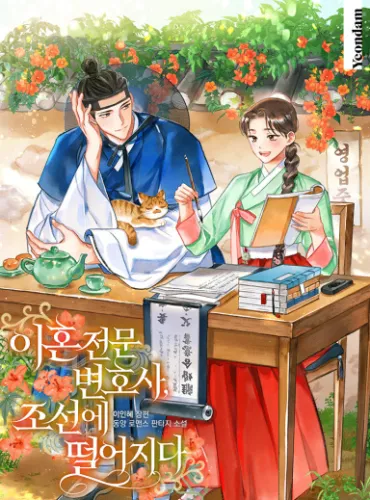
Chapter 6
Beyond Jingogae lay Namchon, the village of scholars—people joked that even if their rice jars were empty, their bookshelves were always full.
And there, in that very place, stood Punguibang—a place that had emptied its bookshelves and filled its rice jars instead.
Among rows of small, aging tile-roofed houses, Punguibang itself appeared modest, with only a sarangchae, an annex, a main house, and servants’ quarters.
But that was only its exterior.
The moment one stepped into the sarangchae, where the master resided, or the annex where guests were received, an entirely different world unfolded.
The room, faintly scented with musk, shimmered in shades of black, red, and gold.
Colored glass lanterns hanging from the ceiling caught the sunlight, casting a spectrum of hues over the rosewood table at the center.
Where scholars of Namchon would normally keep their bookshelves, there instead stood display cabinets filled with priceless items—white porcelain, celadon, even multicolored ceramics from Qing China.
Among them, the most eye-catching were a Western-style clock and a telescope placed at the center of the table.
And beside those rare, priceless objects—items so scarce they could be sold at any price—stood the master of Punguibang, Lee Woon.
Yet despite the room’s dazzling splendor, the most radiant thing there was undoubtedly Woon himself. Before his striking beauty, even gold and jewels seemed to fade.
“Young master, you bought another one?”
The court attendant Gong Chilbok sighed deeply, his hands trembling as he failed to even lift the telescope.
“This? Why do you act like it’s new? I bought it over a month ago.”
“Young master! Punguibang is running a deficit this month—a deficit!”
“And is that because of this telescope? No. It’s because we built homes for those displaced by the Cheonggyecheon flood. Siyoung, tell him—am I wrong?”
Behind Woon, his shadow-like bodyguard Siyoung spoke.
“The young master is correct.”
With Siyoung siding with him, Chilbok shut his mouth—though he still muttered under his breath that they wouldn’t be in the red if not for that purchase.
Woon let out a dry laugh.
“I bought this with my personal funds.”
Chilbok blinked rapidly, then cleared his throat.
“You should have said so earlier.”
“Do I need your permission to spend my own money?”
Woon spoke with mock sternness, and suddenly Chilbok clutched his back and groaned.
“Oh dear, I must’ve hurt my back lifting beams earlier. My whole body aches!”
At Chilbok’s theatrics, Woon shook his head.
He set down the telescope and opened the Punguibang ledger.
In an instant, his expression grew serious.
The lighthearted air vanished, replaced by a quiet dignity—like an orchid that retained its fragrance even in muddy waters.
Just last month, the list of requests had been packed.
But this month, it was nearly empty.
At this rate, we won’t be able to help the people through the winter…
On the surface, Punguibang appeared to be a business that carried out requests for money—like a private investigation agency or errand service.
But in truth, it was different.
The money they earned was used to help the poor and destitute.
And deeper still…
“Is anyone there?”
A voice from outside interrupted Woon’s thoughts.
Woon and Chilbok exchanged glances.
“It must be a customer!”
Chilbok brightened and rushed outside. Siyoung tightened his grip on his sword, heightening his guard.
Soon, noise erupted outside.
“Why have you come?”
“Where are you from?”
“Did you make an appointment?”
“Who referred you?”
Chilbok fired off a barrage of unnecessary questions for one reason:
To overwhelm the visitor and gain the upper hand—so he could charge a higher fee.
“Seems like a wealthy noble has come. Look at how worked up Chilbok is.”
Woon’s lips twisted, though he should have been smiling at the prospect of profit.
What kind of noble has come today to serve their own interests?
Not a single wealthy client who had visited Punguibang so far had made a request for the sake of others.
The sages taught one to serve the public good, not personal gain—but those with power only cared about filling their own bellies.
Or indulging in trivial pleasures.
The taste in his mouth turned bitter.
Who would stir his anger today?
The faint flame in his dark, gleaming eyes slowly dimmed.
“The guest is coming in.”
With Chilbok’s excited voice, the door opened.
And the moment Woon saw who entered—
The extinguished flame in his eyes flared back to life with a crackle.
The sound of tea being poured softly filled the room.
Woon extended a cup.
“Please, have some.”
Hari, who had been carefully observing his large hands, slowly lifted her gaze.
Woon was smiling gently at her.
Hmm…
Hari narrowed her eyes inwardly.
Why is he so handsome? My transmigrator heart is about to give out.
Even someone as bold as Hari paused at his overwhelming looks.
His skin was so flawless that even dust would feel unworthy to settle on it. His nose and jawline were as elegant as if painted with a brush.
His dark eyes, like polished jade, were deep and tranquil—like a hidden spring in the mountains.
His well-defined red lips brought fruit to mind.
And beneath the musk-filled room, there lingered a faint scent of plum blossoms emanating from him.
This is the male lead’s signature!
Hari wanted to avoid getting involved with a male lead if at all possible.
Especially in Joseon-era novels, male leads constantly encountered assassins, got entangled in political strife, and eventually rose to the throne.
What if he falls for me?
Hari had no intention of living confined in the palace.
Besides, she was deeply skeptical about marriage.
I can’t exactly end the royal bloodline, can I?
Lost in her thoughts, Hari suddenly recalled the novel “Grudges and Bonds.”
Wait, wasn’t the male lead there just a farmhand?
There had been countless scenes of him chopping firewood bare-chested.
The author had described his beast-like physique so vividly it felt real.
Compared to that, the man before her exuded elegance—nothing like someone who’d wield an axe.
A long, refined sword suited him far better.
She could almost picture him standing in a bamboo grove, his robe fluttering as he wielded a blade.
A breathtaking image.
“What brings you here?”
The man—Woon—asked.
Snapping out of her thoughts, Hari picked up the teacup.
“Before I make a request, I have one question.”
“Go ahead.”
“You’ve never chopped firewood before, have you?”
Woon raised an eyebrow.
“Is your request related to chopping firewood?”
“Not exactly, but…”
“I haven’t, but I could. There’s nothing physical I can’t do.”
Only after hearing his confident answer did Hari relax.
He was absurdly handsome—but probably not the male lead.
Her expression softened.
This time, Woon’s eyes narrowed slightly.
Though the season for apricot blossoms had long passed, it felt as though pale pink petals were drifting down like spring rain.
Her demeanor was different from what he had heard.
Without realizing it, he spoke.
“So, what does the young lady of the Chief Censor’s household wish to request of me?”
“You know who I am?”
Only then did Woon realize his mistake as her smile vanished.
He cleared his throat awkwardly, and Chilbok stepped forward.
“You’re quite famous, after all. We’ve heard you work as a legal advocate.”
Woon nodded.
“Yes, I’ve heard the rumors.”
It was a carefully mixed answer of truth and falsehood.
He had indeed heard of Hari—but not through rumors.
Through a report.
“Find out everything about the woman from the Chief Censor’s household.”
That had been Woon’s order to Chilbok seven days ago.
And that order stemmed from a meeting ten days ago—with his older brother, Prince Anjong, Lee Gwang.
The memory surfaced naturally.
“I thought I might play matchmaker for you.”
“You, brother? I’m grateful, but I’m not yet fit to take a wife.”
“Haha, you’re getting ahead of yourself. Before I even said anything, the other party already refused.”
“…What? Refused me? Who?”
Woon had no immediate plans to marry—but he was confident he would make an excellent husband.
Looks? More than good enough.
Skills? Archery, horseback riding, swordsmanship—he excelled.
Status? Royal blood.
Family? Stable.
Even his relationship with his brother was good—no danger of political conspiracies.
And yet, someone had rejected him outright.
His pride was stung—and his curiosity piqued.
“Who is this woman who rejected me so decisively? And why?”
At that moment, Gwang had said:
“An Hari.”
Woon murmured her name softly.
The woman who had given him his first rejection—without ever even meeting him—
Was now sitting right in front of him.